
Planning a software project
The Local “Vibe Coder” vs. the South Asian “Augmented Chad Dev” Who Has a Backup Generator
By Hamza Shahbaz · Code Huddle · Product engineering guides
AI made code cheaper to produce. It did not make reliable software delivery easy. The real competition is no longer “expensive local dev vs. cheap offshore dev.” It is “AI-enabled individual vs. AI-enabled delivery system.” There is a new character in software: Cursor on one monitor, Claude on another, login and Stripe by Sunday—the vibe coder. But there is also the augmented engineer in Islamabad, Lahore, Dhaka, or Bengaluru: same tools, plus review, QA, shared knowledge, redundant connectivity, and sometimes a backup generator. Software has become easier to start. Reliable software delivery has not become easier to buy.
Two characters, one industry shift
You probably know him. He has Cursor open on one monitor, Claude on another, and an app that did not exist on Friday but somehow has login, Stripe and dark mode by Sunday night.
The vibe coder. And I mean that with some respect. AI has made one good developer much more capable than before.
But while working around founders, CTOs and software delivery teams, I keep seeing another character too.
He is sitting in Islamabad, Lahore, Dhaka, Bengaluru, or somewhere else in South Asia.
He has Claude too. He has Cursor too. Same React. Same Node. Same Python.
Except he may also have a tech lead checking the architecture, QA testing the release, another engineer who knows the codebase, two internet connections, a mobile hotspot and, yes, a backup generator that can support for hours straight.
That is the “augmented” part. And that is where the comparison gets more interesting.
1. Everyone has AI now
A few years ago, better tools could be a real advantage. Today, a developer in Manchester and a developer in Islamabad can use the same coding model.
Claude does not become less useful because the developer is in Pakistan. Cursor does not suddenly lose features when the user is in Bangladesh.
Stack Overflow’s 2025 Developer Survey found that 84% of respondents were already using, or planning to use, AI tools in their development process. Among professional developers, 51% said they use AI tools daily.
So access to AI is quickly becoming normal. The more useful question is: what happens around AI?
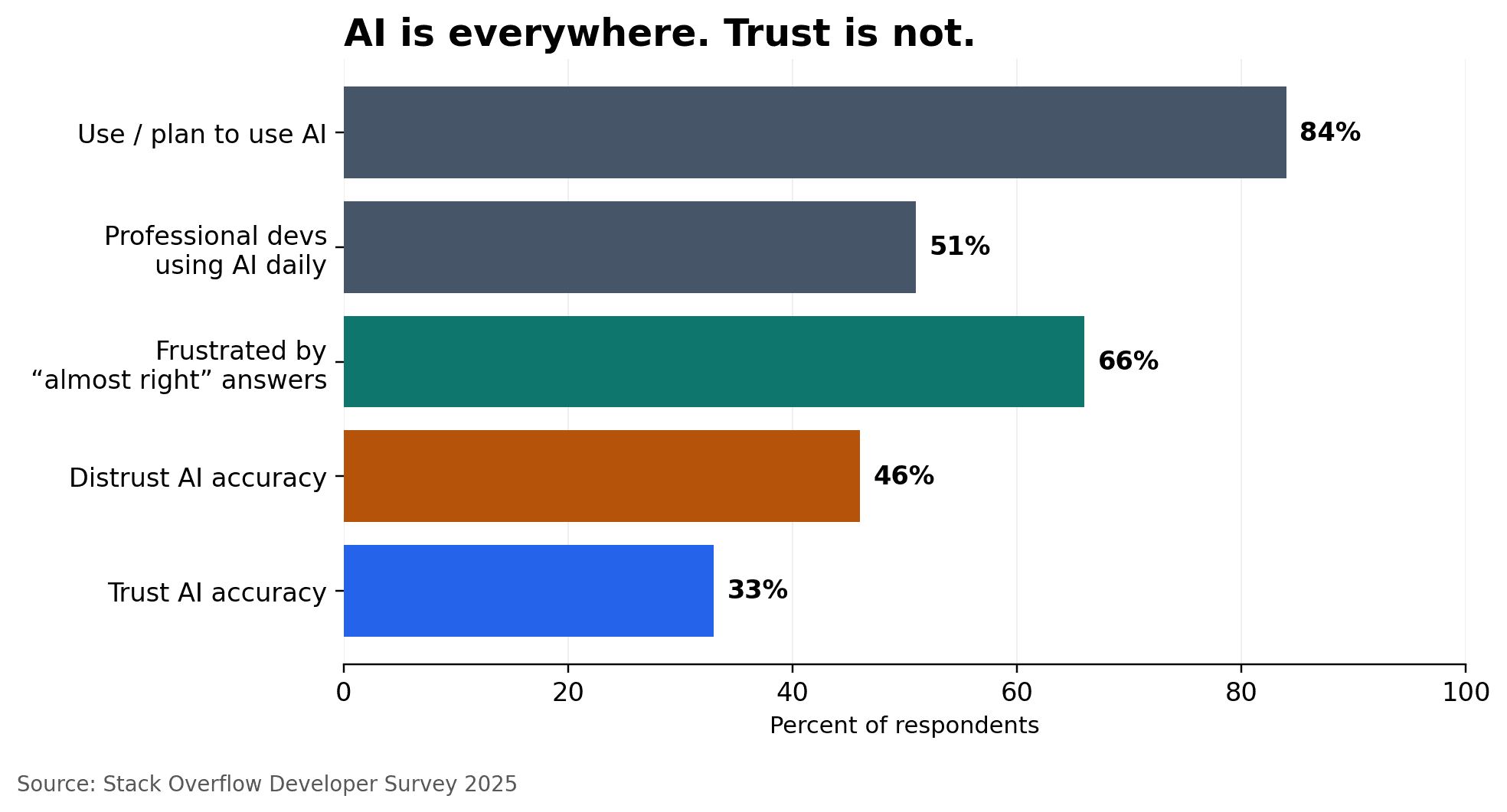
Attribution: Stack Overflow Developer Survey 2025. These figures come from separate survey questions, so they should not be treated as parts of one total.
The same survey also found that more developers distrust AI accuracy than trust it. And 66% said a big frustration is getting an answer that is almost right, but not quite.
That “almost” matters. Because “almost right” is funny in a weekend prototype. It is less funny when the mistake is in permissions, payments, production data or security.
2. The vibe coder optimises for: “Look what I built.”
A business has another question: “What happens to it next?”
Getting a dashboard to load is one job. Making sure one customer cannot see another customer’s data is another.
Getting Stripe checkout working is one job. Handling retries, failed webhooks, refunds and duplicate events is another.
Getting an AI feature to give one nice answer in a demo is one job. Watching cost, latency, bad inputs, hallucinations and failures once real users arrive is another.
The first half looks great in a demo video. The second half is where software becomes a business system.
This is why I do not think vibe coding is replacing software engineering. It is changing where engineering starts.
Google DORA’s 2025 message is useful here: successful AI adoption is a systems problem, not only a tools problem. The surrounding practices decide whether local speed turns into real product performance.
Attribution: Google Cloud / DORA, State of AI-Assisted Software Development 2025.
3. AI can make you feel fast without making delivery faster
I use AI every day, so this is not an anti-AI point.
But one study from METR is useful because the result was inconvenient.
METR studied 16 experienced open-source developers doing 246 real tasks in projects they already knew well. Before the study, the developers expected AI to make them 24% faster. After the study, they still felt AI had made them about 20% faster.
The measured result was the opposite: with the early-2025 AI tools used in that study, they took 19% longer.
This does not prove that AI slows developers in general. METR itself warns against that conclusion. The study was narrow: experienced developers, familiar repositories and a specific generation of tools.
But it does prove one useful thing: feeling faster and delivering faster are not always the same thing.
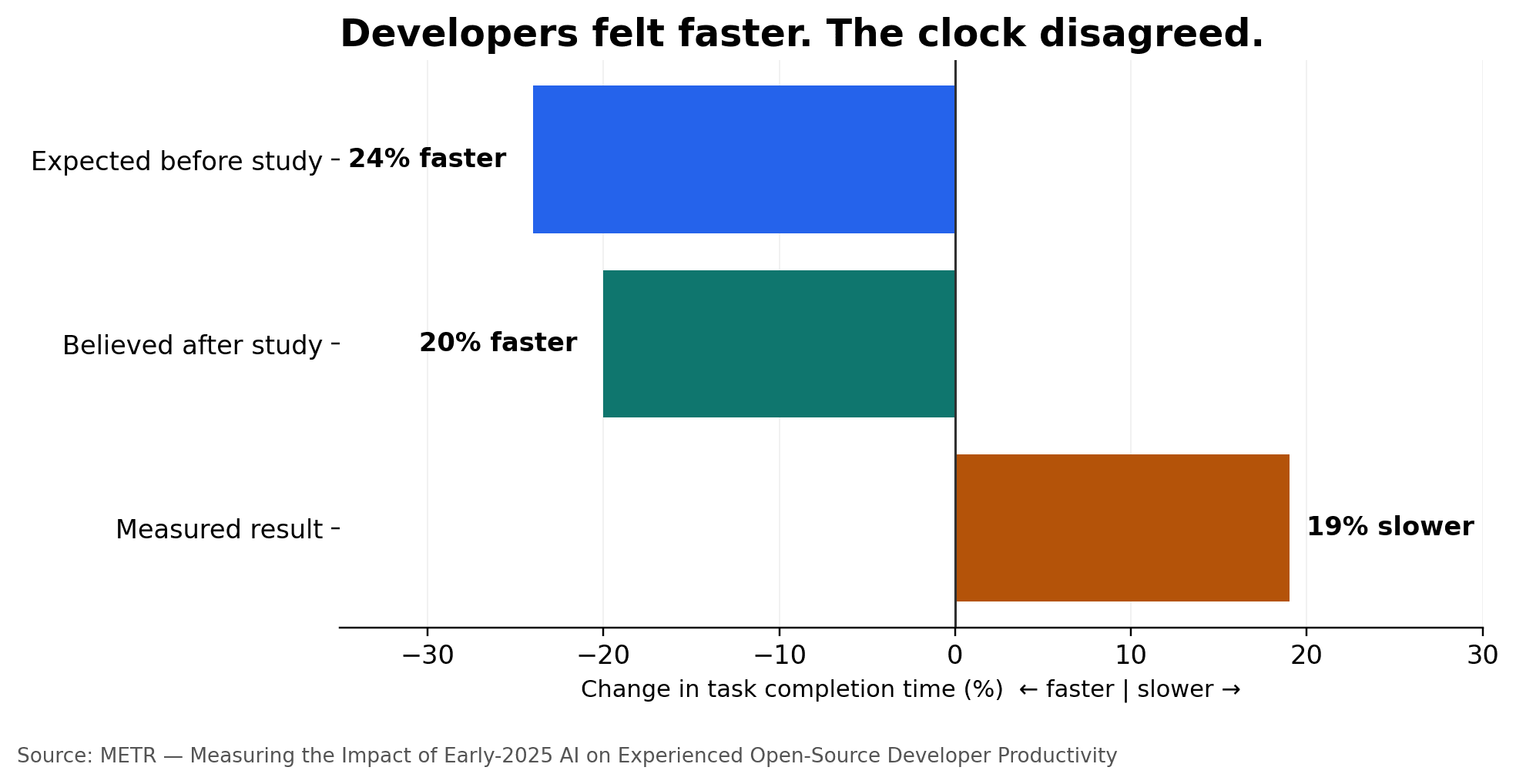
Attribution: METR, Measuring the Impact of Early-2025 AI on Experienced Open-Source Developer Productivity. The study used 16 developers and 246 tasks; it should not be generalized to all software work.
4. Never underestimate the developer who owns a generator
This part started as a joke. The more I thought about it, the more I realised it may be the whole article.
Imagine two developers. One lives twenty minutes from the client. The other lives thousands of kilometres away.
Many buyers will naturally put the second person in the “higher risk” box.
Now look at how many remote teams in markets like Pakistan actually operate.
The power can fail, so there is a UPS. If that is not enough, there is a generator. The internet can fail, so there is another ISP. If that fails too, somebody has a mobile hotspot ready.
The client works in another time zone on the front end, but in the actual circumstances, the offshore developers are available in their time zones, so written down handovers or real time meetings both work. But yes, one should not ignore the fact that the client cannot walk across the room and ask what happened, so updates need to be clearer. One person can leave, so project knowledge needs to exist in more than one head.
The constraint creates redundancy.
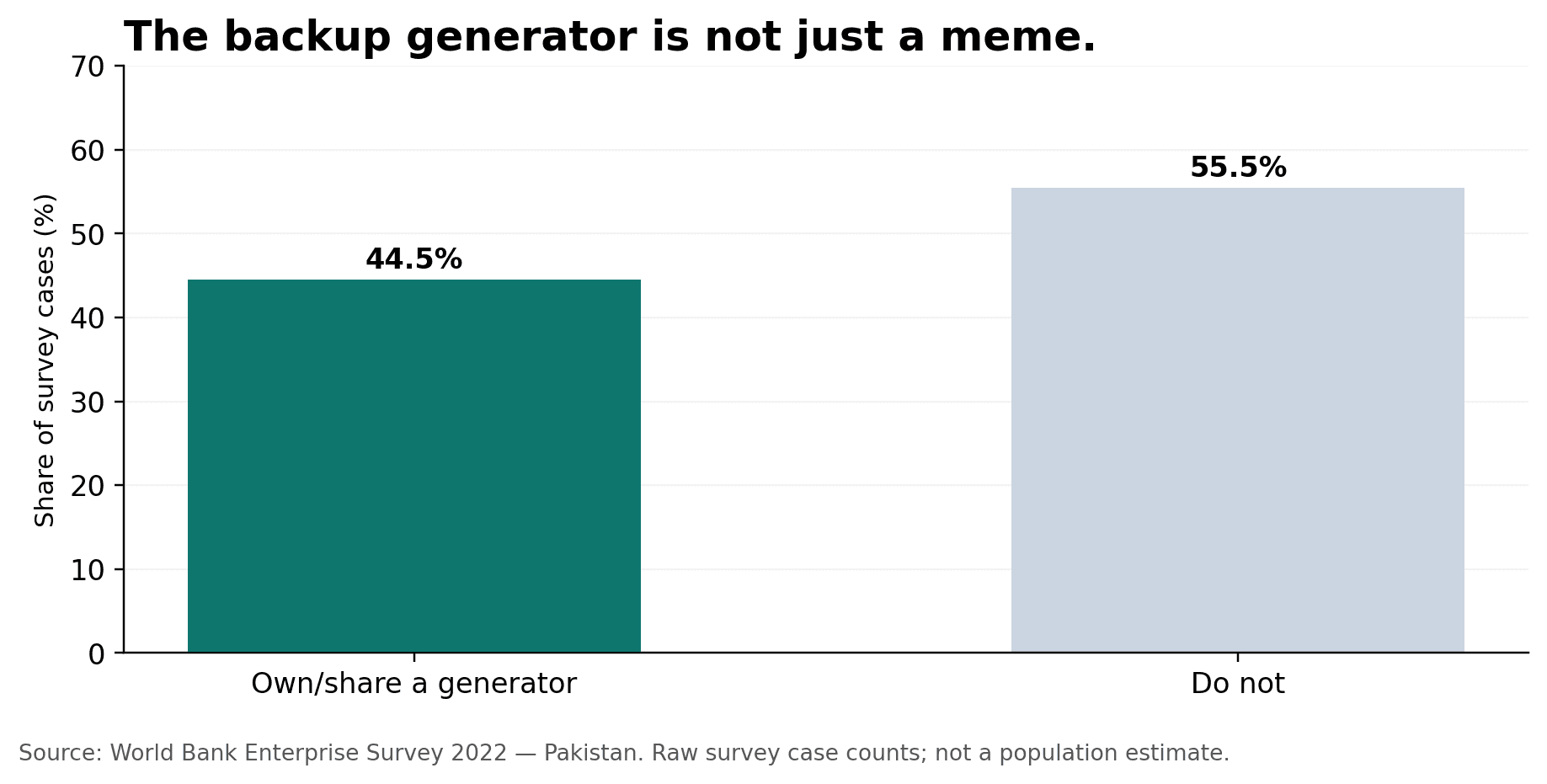
Attribution: World Bank Enterprise Survey 2022 — Pakistan. In the raw file, 578 of 1,300 survey cases answered “Yes” to owning or sharing a generator. The World Bank warns that these raw case counts are not population summary statistics.
That chart is not an IT-industry statistic, and it should not be sold as one. It simply gives context to the joke: business continuity in Pakistan can be something companies physically plan for.
There is a wider commercial signal too. The State Bank of Pakistan reported that ICT services exports reached about US$3.8 billion in FY2025, up 18.3% year over year. Software consultancy and freelance computer services were major contributors.
Again, that does not mean every Pakistani developer is good. It means cross-border software delivery is not some unusual experiment anymore. There is a real industry around it.
Attribution: State Bank of Pakistan, Annual Report FY2025.
Quick outside check: why South Asia / Pakistan is even in this comparison
I do not want to make this a “why hire South Asia” argument. But if South Asia is part of the comparison, it is worth checking whether there is actually enough technical depth there for the comparison to make sense.
There is.
GitHub’s 2025 Octoverse puts India at around 21.9 million developers, the second-largest developer population on GitHub globally. GitHub also reported in its 2024 Octoverse that Pakistan had moved to #20 among developer communities on the platform, overtaking Poland at #21.
Pakistan’s export numbers point in the same direction. The World Bank reported that Pakistan exported about US$4.94 billion in digitally delivered services in 2024, and 58.8% of that came from computer services.
That still does not tell us whether a particular developer, agency or team is good. And it definitely does not mean someone should hire from Pakistan or South Asia simply because they are based there.
It only tells us that this is not a fringe software market. There is a large developer base in the wider region, real cross-border digital delivery, and enough scale that it makes sense to evaluate these teams on the same things we would evaluate anywhere else: skill, process, communication, continuity and output.
There is also a useful reality check here. The same World Bank work points to uneven, lower-quality and relatively costly broadband access in Pakistan.
So the region has both sides of the story: real technical capacity, but also real infrastructure constraints.
And that brings us back to the backup power supply teams like Code Huddle can easily help with, alongside their talent. Not as proof that South Asian teams are better. Just as a good example of why some of them have had to build more redundancy around the way they work.
Attribution: GitHub Octoverse 2025 and 2024; World Bank, Pakistan Development Update 2025.
5. Working code is not the same as safe code
This is another place where “looks finished” can become dangerous.
Veracode tested more than 100 large language models across common programming languages for its 2025 GenAI Code Security Report. Across the tested tasks, 45% of generated samples failed the security tests and introduced a detectable OWASP Top 10 vulnerability.
The important point is not that AI code is always insecure. It is not.
The point is that code can look correct, compile, run, and still be unsafe.
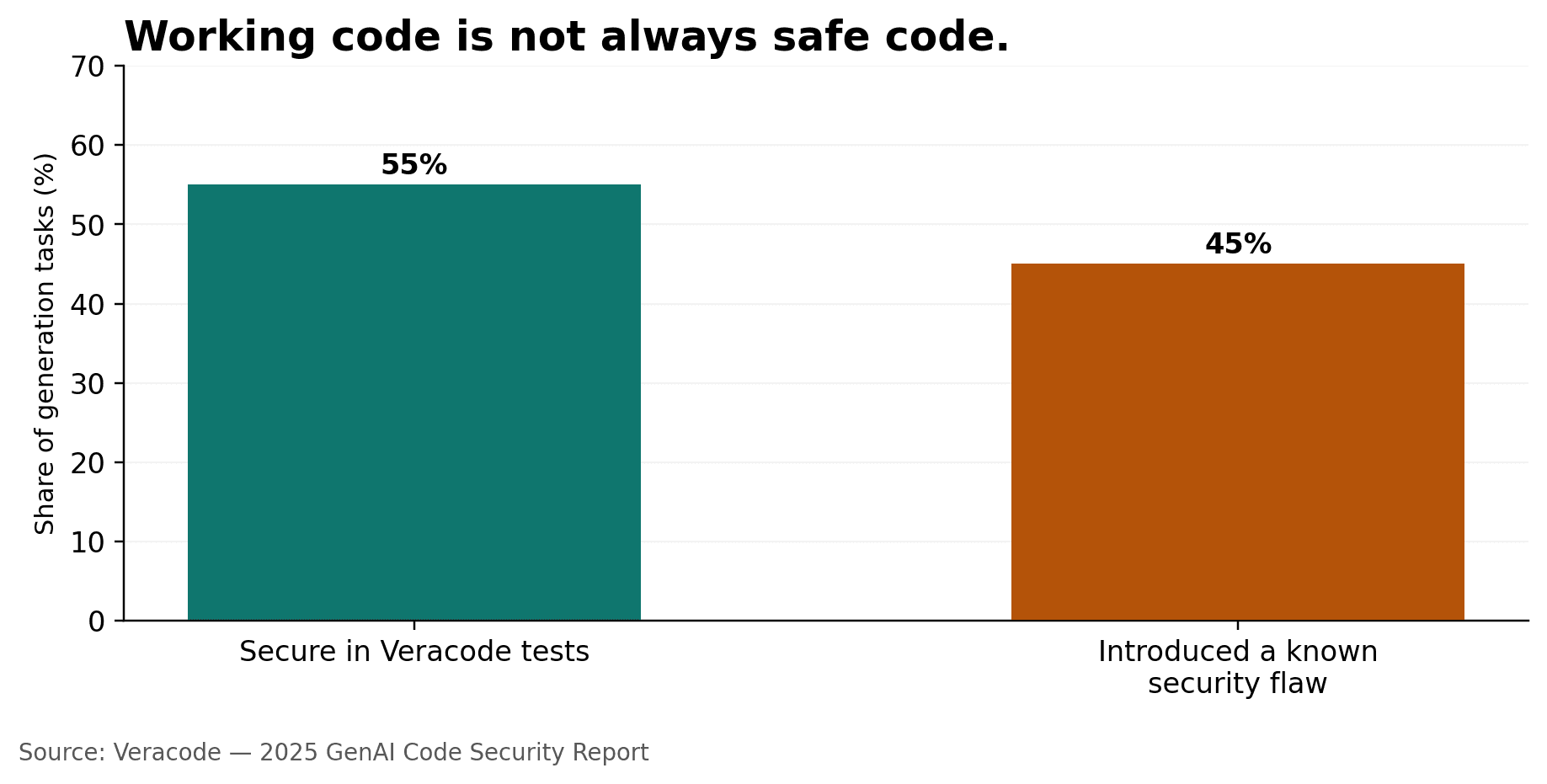
Attribution: Veracode, 2025 GenAI Code Security Report. This is a controlled benchmark of selected tasks and vulnerability types, not a claim that 45% of all production AI code is insecure.
That is where review still matters.
Someone still has to ask: Who can access this endpoint? What happens if the request arrives twice? Where are the secrets stored? What if the third-party API goes down? Who tested the permission boundaries?
AI may help answer every one of those questions. But someone still needs to know that the questions should be asked.
6. “Augmented” is the important word. Not “South Asian.”
I do not want to replace one lazy stereotype with another.
The local engineer is not automatically overpriced. The South Asian engineer is not automatically great. And putting five people into a Slack channel does not magically create a delivery system.
There are bad outsourcing shops. There are bait-and-switch CVs. There are developers sold to three clients at the same time. There are agencies where the senior architect disappears as soon as the sales call ends.
Cheap engineering can become very expensive. So can bad local engineering.
Geography is a poor quality-control system.
The comparison I care about
AI-enabled individual
- Developer + AI
- Fast prototyping
- High personal context
- Can be excellent
- Can also become one point of failure
AI-enabled delivery system
- Developer + AI
- Code review / tech lead
- QA / testing
- Shared project knowledge
- Delivery + continuity + redundancy
Original framework for this article. Not external data.
7. The offshore cost pitch needs to grow up
For years, the offshore pitch was basically: “Our developers are cheaper.”
I think that pitch is getting weaker. And it probably should.
If AI gives each developer more leverage, then the cheapest pair of hands becomes less interesting. The buyer does not only need more hands. The buyer needs more useful output per unit of time, management and risk.
The strongest South Asian teams will not win because they list 47 technologies on a website or because their hourly rate is the lowest.
They will win when they can show one simple thing: One developer does not mean one point of failure.
Do not buy geography. Buy the operating system around the engineer.
8. What should a buyer actually check?
Forget the nationality for ten minutes. Ask the same questions of everyone:
- Who reviews the engineer’s work — including AI-generated code?
- Who owns QA and release testing?
- What happens if this person leaves tomorrow?
- How is production access handled?
- What happens during a power, internet, cloud or key-person outage?
- Where does an engineer go when an architecture decision is above their level?
- How quickly can capacity go up or down?
- How much timezone overlap is actually available?
- Is project knowledge documented and shared?
- What am I really paying for: hours, a CV, output, continuity, expertise, or a delivery system?
Those questions tell you much more than “local or offshore?” ever will.
The winner is not local or South Asian
The winner is the developer — or team — that combines AI leverage with reliable delivery.
Sometimes that is the brilliant developer three streets away. Hire them.
Sometimes it is an augmented engineer thousands of miles away with QA, a tech lead, clear handovers and enough backup power to survive a small apocalypse.
The point is not that South Asia beats local talent.
The point is that AI weakens an old assumption: proximity automatically means safety, while distance automatically means risk.
The tools are spreading everywhere. So the difference moves upward.
From typing speed to judgement.
From coding to architecture.
From implementation to ownership.
From individual output to a delivery system.
From “Can this person build it?” to “Can this system keep delivering it?”
Would suggest evaluating yourself and then making a decision about how to best proceed forward in this competitive world, where the results matter.
Sources and further reading
- Stack Overflow — Developer Survey 2025
- Google Cloud / DORA — State of AI-Assisted Software Development 2025
- METR — Measuring the Impact of Early-2025 AI on Experienced Open-Source Developer Productivity
- World Bank Group — Pakistan Enterprise Survey 2022
- State Bank of Pakistan — Annual Report FY2025
- Veracode — 2025 GenAI Code Security Report
- Andrej Karpathy — original 2025 “vibe coding” framing