
AI product systems
Who Moderates the Moderation AI?
By Minahil Ali · Code Huddle · Product engineering guides
An AI doesn't know what "offensive" means on your platform. Offensive to whom? In what context? Is sarcasm offensive? Is profanity? What about a user quoting something awful in order to criticize it? A model can score text. Deciding what your platform does with that score is a separate engineering problem, and it decides whether your moderation works. So who moderates the moderation AI? You do, through a system built around it. Here's how.
Quick answer: can AI moderate content on its own?
No. AI works well as a first pass, but it needs a written policy, human review for gray-area cases, and regular audits. A moderation model sorts content at high speed. It can't decide your rules, handle every context, or catch its own blind spots. The system around the model is what makes AI content moderation reliable.
What does a moderation model actually do?
It doesn't deliver verdicts. It delivers scores.
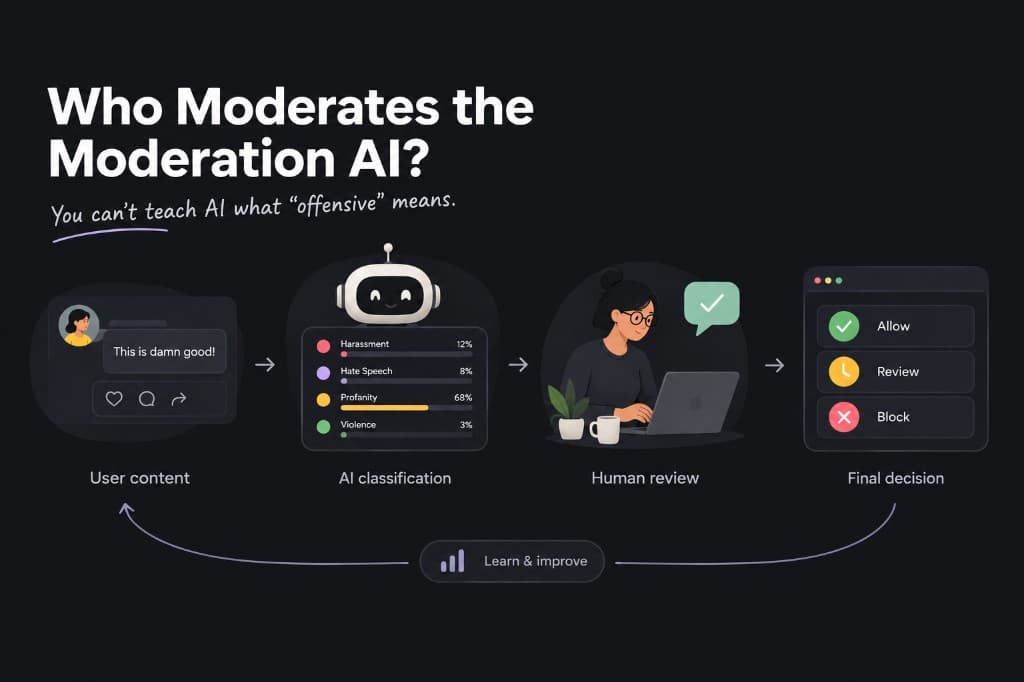
Most moderation models read a piece of text and return a confidence score for each category, such as harassment, hate, violence, sexual content, and self-harm. A post might come back as roughly 72% likely harassment, 31% violence, and close to zero for everything else. (Categories and scales vary by vendor, so check current documentation for the one you use.)
Now the real question: is 72% harassment? Block it, warn the user, or ignore it? The model has no opinion. Your threshold is the opinion. It's a business decision wearing a technical costume.
Why is "offensive" so hard for AI to judge?
Because it isn't one thing. Try these on any classifier and watch it disagree with itself:
"You're killing it today!" — Violent word, friendly meaning
"He called me [slur] and I reported him." — Quoting abuse to criticize it
"Oh great, another genius idea 🙄" — Sarcasm. Insult or joke? Depends on the thread
"This movie was sick, I'm obsessed" — Slang that reads as negative out of context
"Go ahead and unalive yourself" — Coded slang that dodges keyword filters
The same joke in a gaming chat vs. a kids' homework app — Same text, different correct answer
The text didn't change. The context did. Models are strong at patterns and weak at your platform's specific context, which is why a policy has to come first.
Step 1: Write the policy before you pick the tool
If you can't explain your rules to a new human moderator on one page, a model can't enforce them either. A usable policy answers four questions:
What is never allowed? (credible threats, child exploitation, doxxing)
What is allowed but sensitive? (profanity, heated debate, news about violence)
What is context-dependent? (quoting, satire, reclaimed language)
What happens at each level? (remove, warn, limit reach, escalate)
A model without a policy is just a very fast way to be inconsistent.
Step 2: Turn scores into actions with three lanes
Skip the binary "block or allow" setup. Use three lanes instead:
Auto-allow — Low scores across all categories — Content publishes normally
Human review — Middle scores, the gray zone — A person decides
Auto-block — Very high scores on clear violations — Removed, with an appeal option
The middle lane is where the work happens. Obvious cases get automated, ambiguous ones go to a person.
Use different thresholds for different categories. A mid-range score for self-harm should trigger very different handling than the same score for profanity. A single global number is one of the classic mistakes.
Step 3: Plan for human review and appeals
Someone has to look at the gray zone, and users need a way to say "you got it wrong."
Show reviewers context, not just the flagged text: the thread, the user's history, the section of the platform.
Treat appeals as data. Every overturned decision is a labeled example of a mistake.
Protect your reviewers. Rotate exposure to disturbing content and offer support. Clients often forget to budget for this.
Step 4: Moderate the moderator
This step answers the title. Your system drifts because language evolves, with new slang and new evasion tricks, and your users change too. Build a feedback loop:
Sample randomly from every lane, including auto-allowed content, because that's where missed violations hide.
Have humans label the sample, then compare their calls to the model's.
Track two numbers: false positives (good content blocked) and false negatives (bad content missed).
Retune thresholds when those numbers move.
Test adversarial inputs: deliberate misspellings, spaced-out letters, emoji substitution, and other languages.
If nobody audits the AI, the AI is moderating alone. That's the failure.
Why do accurate moderation models still flag so many good posts?
Because of the base-rate problem, and it humbles everyone.
Say your platform gets 1,000,000 posts a day, and 1% are actually bad (10,000 posts). Your model catches 90% of the bad ones and wrongly flags 5% of the good ones. That sounds great. Now run the numbers:
Bad posts caught: 9,000
Good posts wrongly flagged: 5% of 990,000 = 49,500
Total flagged: 58,500
Only about 15% of what you flagged is actually bad.
When bad content is rare, even a strong classifier buries you in false positives. That's why review lanes, tuned thresholds, and appeals exist.
What are the most common AI moderation mistakes?
- No written policy. The model becomes the policy by accident.
- One global threshold. Different harms need different sensitivity.
- Trusting vendor defaults. They fit the vendor's average customer, not you.
- Testing in English only. Performance often drops in other languages, dialects, and code-switching.
- No appeals process. You lose user trust and your best source of error data.
- Never auditing the "allowed" pile. You only see the mistakes you flagged, not the ones you missed.
- Treating launch as the finish line. Moderation is ongoing maintenance, not a one-time feature.
Content moderation checklist
- Written policy with "never / sensitive / context-dependent" tiers
- Per-category thresholds, not one global number
- Three lanes: auto-allow, human review, auto-block
- Reviewers see full context
- Appeals process that feeds back into tuning
- Regular random audits of every lane
- False positive and false negative tracking
- Multilingual and adversarial test set
- Reviewer wellbeing plan
- A named owner for the whole system
Frequently asked questions
What is AI content moderation?
It's the use of machine learning models to detect and sort user-generated content, such as text, images, or video, that may break a platform's rules. The model flags or scores content, and the platform decides what to do with it.
Can AI replace human moderators?
Not fully. AI handles volume and obvious cases well, but humans are still needed for context, nuance, appeals, and policy decisions.
What is a false positive in content moderation?
A false positive is acceptable content that gets flagged or removed by mistake, like a friendly "you're killing it!" being treated as a threat.
How often should a moderation system be audited?
Regularly, and on a schedule someone owns. Weekly or monthly random sampling works for many teams, with extra checks whenever new slang, a new feature, or a new language launches.
Who is responsible when moderation AI makes a mistake?
The platform, not the model. That's why the system needs a named owner, a clear policy, and an appeals path.
So, who moderates the moderation AI?
A written policy, a human review lane, an audit loop, and an owner who's accountable. The model is the fastest part of the system, not the smartest. Treat it like a very quick intern: great at volume, bad at nuance, and in need of supervision.